The Shoreline Premium Matrix
In high-end coastal real estate, distance to the water is the single most critical variable driving land valuation and room-rate psychology. Data from the Knight Frank Global Waterfront Index reveals that prime beachfront homes command an average price premium of 76% over identical inland assets. This financial delta is compressed into a narrow ribbon of land stretching less than 200 meters from the mean high-water mark.
For institutional investors and private equity funds targeting ultra-luxury developments in markets like Phuket, Marbella, or Miami Beach, this spatial relationship is non-linear. The transition from a true beach-adjacent plot to an inland parcel results in a steep valuation cliff. A property situated 15 meters from the sand operates in an entirely different financial ecosystem than one located 150 meters away, even if both claim an identical zip code.
Empirical evidence from hedonic pricing models indicates that every meter closer to the surf yields an exponential increase in nightly rental capacity. However, this proximity introduces acute engineering demands and legal constraints. Understanding the micro-metrics of coastal placement is no longer just a design choice; it is an indispensable element of risk management and asset optimization.
The Proximity Dilemma
The primary error made by speculative developers is failing to distinguish between visual proximity and structural distance. A villa perched on a 30-meter cliff possesses an exceptional ocean view, but lacks direct sand integration. Conversely, a low-lying dune villa provides immediate water access but faces enhanced vulnerability to storm surges, sand accretion, and microclimate degradation.
When developers fail to calculate exact distance metrics, they run into severe regulatory setbacks. Environmental protection zones and maritime public domain laws enforce strict high-tide setbacks that can stall construction for years. In regions like the Balearic Islands or Zanzibar, building just 5 meters inside a protected coastal zone can result in immediate demolition orders and millions in lost capital.
Furthermore, extreme proximity accelerates asset depreciation. Salt spray, humidity, and constant exposure to ambient sodium chloride molecules cause galvanic corrosion in standard structural metals. Without a precise understanding of how distance correlates with structural degradation, maintenance budgets can swell by 300%, completely eroding the projected net operating income of the property.
Spatial Valuation Strategies
The Zero-Meter Interface
The zero-meter interface represents the pinnacle of luxury real estate, where the edge of the villa deck directly fuses with the sand line. In this zone, privacy must be engineered architecturally rather than geographically. Because public foot traffic often passes close to the property boundary, clever landscaping, elevated infinity pools, and one-way smart glass are required to maintain exclusivity.
From an income perspective, properties inside this zone command the highest daily rates. Case data from luxury rental platforms demonstrates that zero-meter positioning allows operators to charge up to a 45% premium over villas situated just across a coastal access road, making this ultra-thin strip the most fiercely contested real estate globally.
The Setback Buffer Zone
Operating between 30 and 100 meters from the high-tide line, the setback buffer zone balances premium ocean access with enhanced structural safety. This distance significantly reduces the impact of wave energy during extreme weather events. It allows developers to create multi-tiered landscaping structures that shield the primary living areas from onshore wind shear.
This zone is often dictated by regional legislation, such as the Spanish Coastal Law (Ley de Costas), which mandates specific protective margins. Properties within this distance metric benefit from lower structural maintenance schedules while still retaining the auditory and visual feedback of the ocean, which is critical for securing high-yield institutional appraisals.
The Elevated Crest Placement
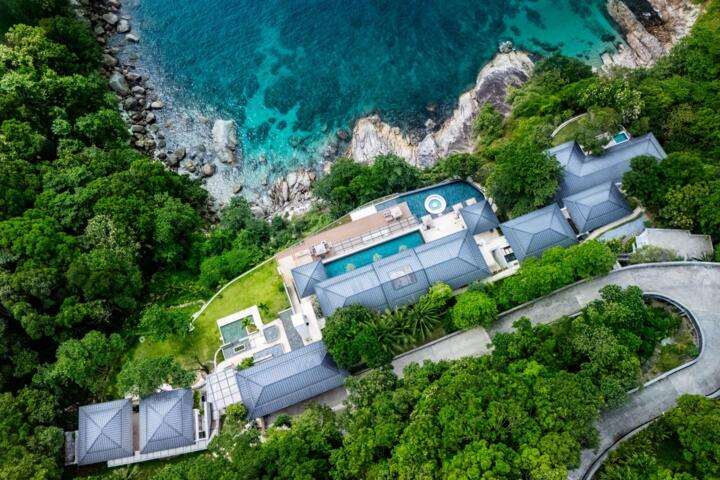
Elevated crest placement utilizes vertical distance to capture panoramic views while maintaining a horizontal distance of 100 to 300 meters from the water. This approach is highly effective in topography-rich zones like the Amalfi Coast or Kamala in Phuket. By leveraging elevation, developers can maximize privacy and eliminate public noise pollution completely.
The financial trade-off involves transport logistics and beach accessibility. To maintain a luxury experience, properties in this tier must integrate private funiculars, golf cart paths, or deeded beach-club access. The structural investment shifts from salt-mitigation technologies to deep caisson foundations and advanced retaining wall engineering.
The Road Disconnection Margin
A critical distance metric is the presence of a coastal transit corridor between the villa and the sand. Even if a property is physically located 20 meters from the water, the intervention of a two-lane road creates a psychological barrier. This disruption reduces the asset's rental tier from "Beachfront" to "Ocean View," resulting in a documented 20% contraction in historical capital appreciation.
To mitigate this valuation discount, premium developments use subgrade pedestrian tunnels or private overhead walkways. These architectural interventions reconnect the asset to the shoreline, restoring a seamless experience and allowing the property to recapture a significant portion of the primary beachfront pricing structure.
The Microclimate Decline Factor
Analysis of airborne salinity demonstrates that corrosive salt spray drops off significantly beyond the 150-meter mark. Properties constructed beyond this threshold experience up to 60% less degradation of external HVAC condensers, structural steel columns, and glazing seals. This distance metric allows the use of standard high-grade construction finishes rather than specialized marine-grade alloys.
This zone represents the optimal sweet spot for long-term hold portfolios. By placing ancillary amenities like tennis courts, guest pavilions, and administrative offices outside the high-salinity zone, developers can slash ongoing operational expenses while concentrating capital investment on the immediate shoreline components.
Empirical Coastal Analytics
A detailed review of a luxury resort development in Antigua illustrates the financial realities of proximity metrics. The developer originally planned a uniform row of 12 villas situated 50 meters back from the high-tide line. Following an optimization study, the layout was altered to a tiered configuration: 4 ultra-premium villas at the 15-meter mark, and 8 stepped villas ranging from 60 to 120 meters.
The asset reorganization yielded immediate dividends. The 4 frontline villas achieved a 76% higher nightly rate than the original uniform projection. Meanwhile, the remaining 8 villas maintained stable occupancies due to enhanced privacy and panoramic views afforded by the tiered topography. Total project gross revenue increased by $4.2 million within the first 18 months of operation.
Conversely, an unmitigated project in a high-surge zone in Costa Rica experienced severe sand erosion and foundation exposure within 36 months of completion. Because the structure was built a mere 8 meters from an shifting shoreline without deep pile foundations, the property required a $1.1 million seawall retrofitting, illustrating the dangers of prioritizing short-term aesthetics over rigorous distance metrics.
Proximity Valuation Metrics
| Distance | Premium | Risk Level | Main Focus |
|---|---|---|---|
| 0–30m | 70%–90% | Extreme | Corrosion |
| 30–100m | 40%–60% | Moderate | Setbacks |
| 100–300m | 20%–35% | Low | Elevation |
| 300m+ | Baseline | Minimal | Logistics |
Mitigating Proximity Risks
To safeguard investments within the 0 to 50-meter zone, developers must abandon standard building specs in favor of infrastructure tailored for marine environments. Utilizing 316-grade stainless steel components, or duplex alloys where load requirements are extreme, is mandatory to prevent structural failure. Standard structural steel will experience rapid oxide expansion, fracturing surrounding concrete within years.
Hydrodynamic forces present another significant hazard. Foundations within the immediate tidal interface must be anchored into solid bedrock via deep reinforced concrete piles, rather than relying on shallow slab configurations. This configuration allows the structure to withstand severe wave action and sudden beach erosion during significant storm events.
Finally, architectural design must incorporate active sacrificial elements. This means structuring the ocean-facing facade with easily replaceable glass balustrades, external cladding panels, and mechanical louvers. By isolating the inevitable effects of salt weathering to non-structural, modular components, operators can maintain a premium aesthetic without engaging in costly structural overhauls.
FAQ
What is a safe setback?
A safe setback varies by geography, but a conservative global benchmark is 50 meters from the historical maximum high-tide line. This buffer protects against typical erosion cycles while maintaining the premium beachfront designation required for high-yield luxury positioning.
How does salt spray travel?
Significant salt spray concentration typically travels up to 150 meters inland under standard wind conditions. Beyond this distance, the atmospheric salt concentration drops rapidly, resulting in lower structural degradation and reduced ongoing maintenance costs for the property.
Are cliff villas secure?
Cliff villas are structurally secure if anchored by deep piles, but they face distinct risks such as rock fall, slope failure, and seismic vulnerability. Extensive geotechnical engineering core drilling is required to verify the integrity of the rock strata before commencing construction.
How do roads affect value?
A public road between the property and the beach introduces a significant visual and audible disruption. This can reduce the property's rental yield by up to 25% and compress capital appreciation margins compared to true, uninterrupted beachfront land parcels.
What is marine steel?
Marine steel refers to 316-grade stainless steel or specialized alloy coatings that contain molybdenum. This specific element increases the metal's resistance to pitting and crevice corrosion caused by exposure to ambient sodium chloride in coastal environments.
Author's Insight
Throughout my career analyzing ultra-luxury resort assets, I have watched developers lose millions by miscalculating the high-tide line. True beachfront luxury is a game of inches, where over-building too close to the surf line triggers regulatory penalties, while building too far back breaks the psychological illusion of exclusive ocean access. My definitive recommendation for anyone targeting high-yield coastal deployment is to invest heavily in a detailed geotechnical and tidal analysis before executing land acquisition. A premium view is useless if the sand beneath your foundation is structurally unstable.
Summary
Maximizing the valuation of a luxury beachfront villa requires a precise balance between shoreline proximity and structural resilience. Assets placed within the 0 to 30-meter zone command premium rental returns but demand specialized marine-grade materials and deep caisson engineering. By utilizing smart architectural designs, respecting legal setbacks, and deploying tiered layouts, developers can insulate their portfolios against coastal wear. Prioritize rigorous spatial data over basic aesthetic appeal to ensure your shoreline asset appreciates securely over time.