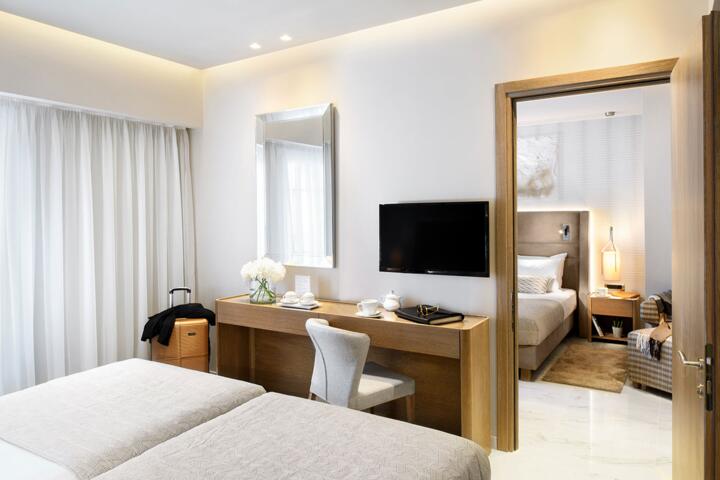
Connecting Rooms: The Basics
Connecting rooms are two separate hotel rooms connected by an internal door, usually inside the same hallway or corridor. Guests can move between rooms without going through the main lobby, which changes the day-to-day experience for families, caregivers, and small groups. Many hotels also offer “adjoining” rooms, which sit next to each other but do not have a door between them; the wording matters when you request a specific setup.
In practice, connecting rooms reduce friction during bedtime routines, late-night check-ins, or when one person needs to step out while another stays in. A common example: two parents can keep one child’s room quiet while still checking on the other child without walking down a corridor. Another example: a caregiver can monitor a guest with mobility needs without repeated elevator rides or hallway navigation.
Noise control depends on construction. Some internal doors are solid and well-fitted, while others are lighter and transmit sound more easily. If you are sensitive to noise, you will want to ask about door type, wall thickness, and whether the rooms share any ventilation paths.
Common Booking Mistakes
People often request “connecting rooms” as a single phrase and then stop there. Hotels may interpret that as “adjoining rooms,” especially if inventory is limited. The result can be two rooms next to each other with no internal access, which defeats the main reason to ask.
Another frequent issue is assuming the rooms will match your needs. A connecting-door layout can place one room near elevators, housekeeping closets, or ice machines, depending on the building plan. Even if the door between rooms exists, the outside-facing windows and street noise can still affect sleep.
Availability is also time-sensitive. Connecting rooms are a smaller subset of inventory, so the hotel may only hold them for certain room categories or for specific dates. If you book late, you may get a partial match: one room type you wanted, but not the exact configuration.
Supporting systems matter too. Hotels rely on room-mapping software and housekeeping schedules to assign adjacent inventory. If the internal door is blocked for maintenance or if one room is out of service, the hotel may switch you to adjoining rooms. That swap rarely shows up in the online description, and it happens more often during high occupancy periods.
How To Request Them
Ask With Specific Criteria
Request connecting rooms with a short list of constraints. Include the number of guests, bed setup (for example, two queens in each room), and any accessibility needs. If you need a quiet location, ask for rooms away from elevators and vending areas. When I’m booking for a family, I also ask whether the internal door has a latch that closes fully, because some doors feel “drafty” even when they close.
Use the hotel’s booking channel that gives you the most control. A direct call to the property can clarify whether the door is present and whether both rooms are the same category. If you book through an online travel agency, send the request through the message system tied to your reservation, then confirm by phone once you have a reservation number.
Timing helps. Contact the hotel after booking and again 24–72 hours before arrival. Many properties can still adjust assignments during that window, but they cannot always change room types at the last minute.
Check Layout, Not Just Category
Connecting rooms vary by building. Some are true side-by-side rooms with a door in the middle wall; others are arranged so that one room’s entry is closer to the corridor. Ask whether the connecting door is between the bathrooms, between the bedrooms, or between living areas. If you travel with a baby, you may care more about where the door sits relative to the crib area.
Also ask about sound. You can request “quiet connecting rooms” and mention that you are sensitive to hallway noise. If the hotel can share details like “solid core door” or “double door with seals,” that information is more useful than a generic promise.
For families, consider the bathroom situation. Two rooms with one shared bathroom are rare in hotels, but some properties offer suites where the connecting door leads into a shared foyer. That can change privacy and how quickly you can get ready in the morning.
Plan For Partial Matches
Even with a correct request, the hotel may offer adjoining rooms if connecting inventory is unavailable. Decide in advance what you will accept. For example: adjoining rooms are acceptable only if they are on the same floor and within a short distance, and if the rooms are the same bed category.
Ask what happens if the hotel cannot deliver connecting rooms. Some hotels can move you to a different room category, while others can only swap within the same category. If you have a non-negotiable need—like accessibility or a specific bed configuration—state it clearly.
Keep documentation. Save the confirmation email and any message thread. If you need to escalate, having the exact wording of your request helps staff interpret what you meant.
Use Realistic Expectations
Connecting rooms do not guarantee silence. Internal doors reduce the need to walk through hallways, but they do not block all sound. Expect some noise transfer from voices, TV volume, and bathroom plumbing. If you plan to stay up late in one room, consider earplugs or a lower volume policy.
Also expect trade-offs. Hotels may place connecting rooms in older wings with different acoustics, or they may charge a higher rate for the room category. In some properties, the internal door can reduce usable wall space, which affects where beds and desks fit.
A practical outcome target: if you request connecting rooms early and confirm closer to arrival, you improve your odds of receiving the door between rooms. The exact probability varies by property and date, so treat it as a likelihood rather than a guarantee.
Educational Case Examples
Scenario 1: Family with bedtime routines. A family books two rooms for four nights. They request connecting rooms with two queens in each room and ask for rooms away from elevators. The hotel confirms the internal door exists, but one room is near a housekeeping closet. The family solves the noise issue by requesting a room change the next day, after observing the corridor traffic pattern.
Scenario 2: Caregiver support for mobility needs. Two guests share a trip: one uses a mobility aid and one is a caregiver. They request connecting rooms so the caregiver can assist without repeated hallway travel. The hotel assigns connecting rooms on the same floor, but the internal door is narrower than expected. The caregiver brings a small mobility-friendly mat and uses the bathroom layout to reduce tight turns, then asks staff for a quieter corridor location for the second night.
Checklist: Decide Before You Book
| Decision Point | What To Ask | Why It Matters | If They Can’t Do It |
|---|---|---|---|
| Door Between Rooms | “Is there an internal connecting door, not just adjoining rooms?” | Adjoining rooms do not provide internal access. | Ask for same-floor adjoining rooms within a short distance. |
| Bed Setup | “Do both rooms match the bed type I booked?” | Layout constraints can change bed placement. | Confirm whether swaps change the rate or cancellation terms. |
| Noise Location | “Can you place connecting rooms away from elevators and service areas?” | Corridor traffic can affect sleep. | Request a room change after arrival if noise is unacceptable. |
| Accessibility Fit | “Is the connecting-door width suitable for my mobility aid?” | Door width and bathroom turns affect movement. | Ask for an alternative room type or a different floor plan. |
If you want a quick step-by-step checklist: book early, request connecting rooms with bed and noise criteria, confirm by phone, and re-check 24–72 hours before arrival. On my last trip planning session (I used a hotel app version 3.2.1 on 2026-02-10), the message thread showed “adjoining rooms requested,” which was not the same as “connecting door.” That mismatch is easy to miss unless you verify the wording.
Common Mistakes To Avoid
One mistake is treating “connecting rooms” as a guaranteed feature rather than an assignment request. Hotels can change room assignments due to maintenance, late arrivals, or housekeeping constraints. Your best defense is written confirmation and a clear fallback plan.
Another mistake is ignoring the difference between room category and room configuration. A “family room” category might include multiple layouts, and only some have internal doors. If you need a specific bed count or bathroom arrangement, ask for the configuration details.
People also overestimate soundproofing. Internal doors reduce hallway walking, but they do not create a sound barrier like a separate apartment. If you plan to watch TV late or talk loudly, you may still disturb the other room.
Finally, avoid waiting until check-in to raise issues. If the hotel assigns adjoining rooms, ask immediately for the closest alternative. Staff can sometimes move you within the same day, but the options shrink after housekeeping completes the room turnover.
FAQ
Are Connecting Rooms The Same As Adjoining?
No. Connecting rooms have an internal door between the two rooms. Adjoining rooms are next to each other without that internal access, so you still need to go through the corridor.
Can Hotels Guarantee A Connecting Door?
Hotels can confirm availability at booking or during assignment, but they may change rooms due to maintenance or inventory shifts. Ask for written confirmation and a fallback option if connecting rooms are unavailable.
Do Connecting Rooms Reduce Noise?
They can reduce corridor noise because you avoid hallway traffic between rooms, but sound can still travel through the internal door and shared walls. Request quieter locations if sleep is a priority.
What Should I Ask For When Booking?
Ask whether the internal door exists, confirm bed types in both rooms, request a floor away from elevators or service areas, and mention any accessibility needs. If you have a specific concern, state it in one sentence.
What If The Hotel Assigns Adjoining Rooms?
Ask for the closest alternative on the same floor and within the same room category. If a connecting door is non-negotiable, request a room change or consider a different property for future dates.
Author's Insight
Connecting rooms are a practical accommodation choice when your travel plan depends on internal access between two sleeping areas. The main benefits come from reducing hallway movement and simplifying supervision during routines like bedtime or caregiving. The main limitations come from assignment variability and acoustics, since internal doors do not equal full soundproofing.
For decision-making, treat “connecting rooms” as a request that depends on inventory and building layout. Your best results come from specifying bed setup, noise preferences, and accessibility needs, then confirming the wording close to arrival.
If you need a medical or accessibility fit, verify door widths and bathroom turns with the property before travel. If the hotel cannot meet the configuration, a nearby alternative room plan can be a safer choice than assuming the layout will work on arrival.
Key Takeaways
- Connecting rooms include an internal door; adjoining rooms do not.
- Request connecting rooms with bed setup, noise location, and accessibility criteria.
- Confirm by phone and re-check 24–72 hours before arrival to catch assignment mismatches.
- Plan a fallback if the hotel cannot deliver the connecting door, since inventory can change.