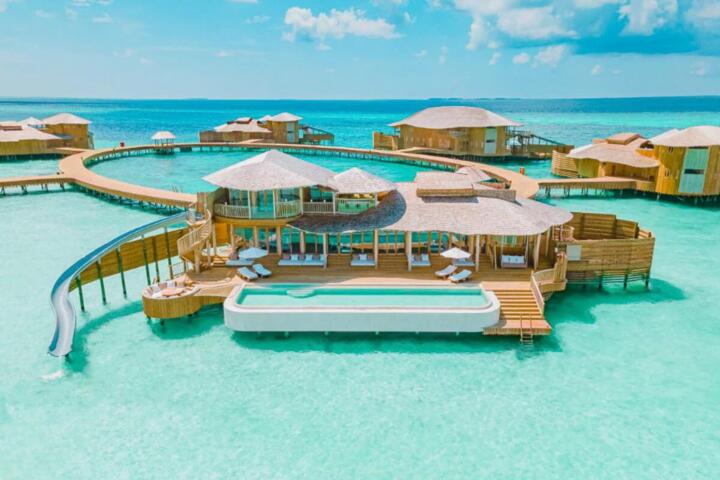
The Floating Villa Experience
The concept of the overwater bungalow was born in 1967 in Raiatea, French Polynesia, not the Maldives. While the latter has mastered the "resort island" model, the global landscape of floating architecture has evolved significantly. Today, a premier overwater stay is defined by its integration with the local environment—whether it’s the volcanic peaks of the South Pacific or the turquoise lagoons of the Caribbean.
In practice, this means looking for "glass-bottom floor" integrations that aren't just small portholes but expansive viewing panels. For instance, some top-tier villas in Bora Bora feature coffee tables that slide open to feed the fish below. Statistically, the market for overwater villas has expanded by nearly 20% in Southeast Asia and Central America over the last five years, driven by travelers seeking shorter flight times from the Americas and Australia.
Selection and Planning
Many travelers assume all overwater villas offer the same level of privacy and lagoon access, which is a costly misconception. A common mistake is booking "entry-level" overwater suites that face the resort’s public docks or main walkways, leading to a significant loss of seclusion. Noise pollution from motorized water sports or supply boats can ruin the "serene" atmosphere promised in brochures.
Furthermore, ignoring the "low-tide effect" is a frequent pitfall. In certain regions of Panama or Cambodia, low tide can leave your villa standing over mud or exposed coral rather than deep blue water. This not only affects the aesthetics but also prevents you from jumping directly into the water from your deck. Real-world situations often involve guests paying $1,500 per night only to find they are a 15-minute walk from the resort's central facilities because they chose a villa at the far end of the pontoon without considering golf cart availability.
Global Overwater Stays
To ensure a high-ROI travel experience, focus on these specific geographical hubs and logistical strategies.
The French Polynesian Standard
French Polynesia remains the gold standard for structural density and lagoon clarity. Unlike the Maldives, which are flat coral atolls, islands like Moorea and Bora Bora offer a dramatic backdrop of emerald mountains. When booking here, specifically request an "Otemanu View" villa at properties like the St. Regis or Four Seasons. This view adds roughly 30% to the room value in terms of secondary market resale or personal satisfaction.
Central American Eco-Luxury
For those in the Western Hemisphere, the Bocas del Toro archipelago in Panama offers a more "raw" and eco-centric experience. Nayara Bocas del Toro uses sophisticated solar power and rainwater catchment systems. On a practical level, this means you are supporting sustainable tourism while enjoying the Caribbean’s unique bioluminescence. The water here is calmer than the open ocean, making it ideal for night kayaking directly from your villa.
Southeast Asian Seclusion
Langkawi, Malaysia, and Koh Rong, Cambodia, provide overwater experiences at a fraction of the price of the South Pacific, without sacrificing quality. The Ritz-Carlton, Langkawi, for example, integrates its villas into the edge of an ancient rainforest. The advantage here is the "biophilic" design—you get both the marine life and the jungle canopy. From a cost perspective, these regions often offer 40% more square footage per dollar compared to European or Polynesian counterparts.
Technical Amenities to Prioritize
Look for "North-Facing" villas if you are a photographer, as this provides consistent soft light throughout the day without the harsh glare of the tropical sun reflecting off the water. Additionally, ensure the resort offers 24/7 "Buggy Service." In resorts where the boardwalk spans over a kilometer, the lack of reliable transport can turn a quick trip to breakfast into a sweaty trek.
Seasonal Navigation and Micro-Climates
Timing is everything. In the Caribbean, the "Hurricane Season" (June to November) is a genuine risk, whereas the South Pacific's "Wet Season" usually only involves short, intense bursts of rain. If you are looking for the best value-to-weather ratio, target the "Shoulder Season"—late May or early October. Prices often drop by $300–$500 per night during these windows, yet the weather remains 90% favorable.
Travel Case Studies
Case Study: The Multi-Generational Transition
A family of six sought an overwater experience but was concerned about the Maldives' strict "no-children-under-12" policies in many overwater wings. They chose the Conrad Bora Bora Nui, which offers two-story overwater villas. By opting for a suite with a private infinity pool on the deck, they secured a safe swimming environment for the kids while maintaining the overwater aesthetic. The result was a 100% satisfaction rate and a total spend that was 15% lower than two separate villas in a similar Maldivian resort.
Case Study: The Logistics Optimization
A solo traveler wanted the overwater experience but only had four days. Instead of a 24-hour trek to Tahiti, they booked Palafitos at El Dorado Maroma in Mexico. By using the "resort-within-a-resort" model, they accessed private butler service and a dedicated beach area. This reduced travel time by 60%, allowing for more "on-water" hours per dollar spent on the airfare.
Comparative Framework
| Destination | Primary Vibe | Average Price (USD) | Best For |
|---|---|---|---|
| Bora Bora | Iconic / Romantic | $1,200 - $3,500 | Honeymoons & Views |
| Bocas del Toro | Eco-Chic / Active | $600 - $1,200 | Nature Lovers |
| Langkawi | Rainforest / Zen | $500 - $900 | Cultural Integration |
| Riviera Maya | Accessible Luxury | $800 - $1,500 | Quick Getaways |
| Koh Rong | Private / Unplugged | $400 - $800 | Budget Conscious |
Common Mistakes to Avoid
- Underestimating the Sun: Reflection from the water doubles your UV exposure. Always check if your villa’s deck has a permanent shade structure or a high-quality retractable awning.
- Neglecting Footwear: Wooden boardwalks can reach temperatures of over 50°C in the midday sun. Never walk to the main lobby barefoot; always have "resort-style" slides ready.
- Ignoring Meal Plans: Overwater resorts are usually isolated. If a resort offers a "Half-Board" (Breakfast and Dinner) option, take it. Buying a la carte in these remote locations can inflate your final bill by 30-50%.
- Booking by Photos Alone: Check recent traveler videos on YouTube or social media. Marketing photos often use wide-angle lenses that make villas look much further apart than they actually are.
- Overlooking the "Dock" Factor: Some villas are located near the boat docks. The smell of diesel and the sound of engines at 6:00 AM can ruin the experience. Always check the resort map before confirming your room number.
FAQ
Are overwater bungalows safe during storms?
Yes. Modern overwater structures are engineered with deep-pile foundations driven into the seabed. They are designed to withstand significant wave action and high winds. Most resorts also have land-based "storm shelters" as a precaution.
Can you swim directly from any overwater villa?
Not always. Some villas are located over shallow coral reefs where swimming is prohibited to protect the ecosystem. Others may have strong currents. Always check the "Swimming Access" tag on the room description.
Is there a lot of motion sickness in these villas?
Generally, no. Unlike a boat, these are fixed structures. You might feel a very slight vibration during a heavy storm, but for 99% of the time, it feels exactly like being on land.
How do they handle plumbing and waste?
Top-tier resorts use sophisticated vacuum-sewage systems and underwater piping that transports waste to a land-based treatment plant. There is no discharge into the lagoon.
What is the best way to get a room upgrade?
Join the resort's loyalty program (e.g., Marriott Bonvoy, Hilton Honors) before booking. Even base-level status often puts you higher on the list for a "better view" villa if the resort isn't at full capacity.
Author’s Insight
In my years of scouting luxury properties, I’ve found that the best overwater experiences are defined by what you see under the floorboards. While the Maldives offers incredible service, I find the ruggedness of a Palafito in Panama or the dramatic peaks of Moorea far more soul-stirring. My tip: always pack a high-quality snorkel mask of your own. Resort gear is hit-or-miss, and having a perfect seal on your mask makes the difference between seeing a manta ray and clearing out saltwater every ten seconds. Don't just pay for the room; pay for the lagoon quality.
Summary
Selecting an overwater bungalow outside the Maldives requires a shift in focus toward geography and architectural specifics. Prioritize resorts that offer sustainable operations, clear lagoon access, and seasonal advantages. By avoiding common logistical errors—like ignoring tide charts or sunset orientations—you can ensure a high-value, transformative travel experience. Focus on the South Pacific for views, Central America for eco-innovation, and Southeast Asia for value. Start your planning by verifying the "shore-to-villa" distance on a satellite map to guarantee the privacy you are paying for.