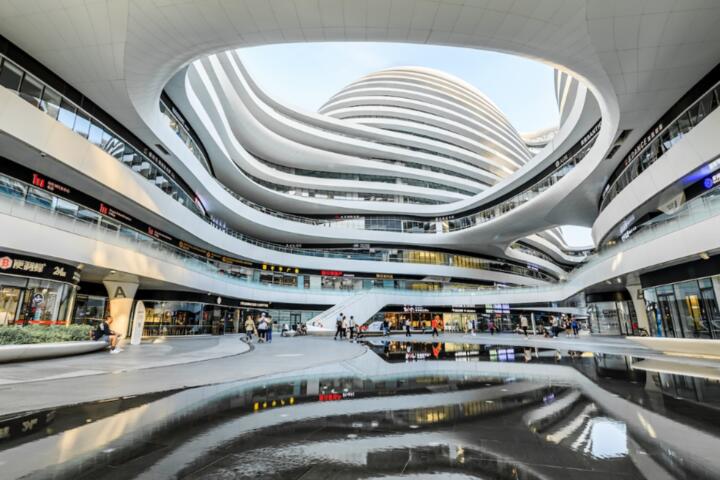
The Evolution of the Smart Metropolis
Architecture has shifted from static silhouettes to "living" organisms. Today’s most advanced cities utilize Building Information Modeling (BIM) and Digital Twins—virtual replicas of physical buildings—to optimize airflow, energy consumption, and light exposure. We are no longer just looking at tall towers; we are witnessing the implementation of bioclimatic architecture where structures respond to their environment in real-time.
A prime example is the use of Ethylene Tetrafluoroethylene (ETFE) in structures like the Water Cube in Beijing or the Eden Project. Unlike glass, ETFE is 1% the weight and a significantly better insulator. In Singapore, the integration of "Green Plots" has reached a point where new developments must replace 100% of the greenery lost on the ground with vertical forests.
Statistically, the construction industry is responsible for nearly 40% of global carbon emissions. The cities mentioned below are not just visual marvels; they are testing grounds for carbon-sequestering concrete and modular 3D-printed housing, aiming to slash that figure by half by 2040.
The Pitfalls of Modern Urban Planning
The most common mistake in modern development is "Form over Function." Many municipalities attempt to replicate the "Bilbao Effect"—where a single iconic building (like the Guggenheim) revitalizes a city—without considering the underlying infrastructure. This leads to spectacular shells that are thermally inefficient or impossible to maintain without astronomical costs.
Another pain point is the "Glass Box Syndrome." Builders often rely on floor-to-ceiling glazing in desert climates, which creates a greenhouse effect. This necessitates massive HVAC systems, essentially nullifying any "green" credentials the building claims to have.
In reality, ignoring the local microclimate leads to structural failure or social isolation. We see this in "Ghost Cities" where the architecture is futuristic, but the human-centric design—walkability, shade, and communal transit—is entirely absent. Without a data-driven approach to human flow, a futuristic city is merely a high-priced museum.
Strategic Innovations in Advanced Construction
Implementing Parametric Design for Climate Resilience
Parametric design uses algorithms to solve complex geometric problems. Instead of drawing a shape, architects input variables like "maximum sunlight" or "wind resistance." Software like Rhino 3D and Grasshopper allows for the creation of facades that self-shade, reducing the need for artificial cooling by up to 30%.
The Rise of Vertical Forestation and Biophilia
Cities like Milan and Singapore are leading the charge in integrating 10,000+ plants directly into skyscraper facades. This isn't just for aesthetics; these plants absorb CO2, filter particulate matter (PM2.5), and reduce the urban heat island effect by 2°C to 8°C. This works because the transpiration of the plants acts as a natural air conditioner.
Smart Transit Integration and Hyper-Connectivity
The future city treats transit as a vertical and horizontal grid. Take the "Link" bridges in the Raffles City Chongqing complex. By connecting four skyscrapers with a sky conservatory 250 meters in the air, the city creates a new "ground level," reducing the need for street-level congestion and maximizing high-density efficiency.
Utilization of Ultra-High-Performance Concrete (UHPC)
Standard concrete is porous and prone to cracking. UHPC, used extensively in Dubai’s latest projects, offers a compressive strength of over 150 MPa (compared to 30-40 MPa for standard concrete). This allows for thinner, more elegant structures that use 40% less material while lasting twice as long.
Decentralized Energy Grids and Solar Skin
The next generation of skyscrapers uses BIPV (Building-Integrated Photovoltaics). These are solar cells embedded directly into the windows or cladding. This allows a 50-story building to act as its own power plant, potentially feeding excess energy back into the city’s smart grid via platforms like Siemens MindSphere.
Architectural Pioneers in Practice
The Singapore Sustainability Model
The Marina Bay Sands and Gardens by the Bay weren't just built to be photographed. The "Supertrees" serve as exhaust vents for the underground biomass power plants. By integrating waste management with public art, Singapore reduced its landfill dependency by 10%. The result is a city-state that maintains a high GDP while increasing its green cover by 20% over two decades.
The Dubai High-Tech Expansion
Dubai shifted from merely "the tallest" to "the smartest." The Museum of the Future utilized a robotic-assisted stainless steel facade consisting of 1,024 unique panels. The project leveraged BIM Level 3, allowing various contractors to work on a single, live digital model. This prevented over 1,500 potential design clashes before ground was even broken, saving an estimated 25% in construction time and waste.
Comparative Framework: Traditional vs. Future-Ready Cities
| Feature | Traditional Urban Centers | Future-Ready Smart Cities |
|---|---|---|
| Primary Material | Standard Concrete & Steel | UHPC, Cross-Laminated Timber (CLT) |
| Energy Strategy | Centralized Grid Reliance | BIPV & Localized Microgrids |
| Data Usage | Reactive Maintenance | Predictive AI & Digital Twins |
| Water Management | Storm Drains to Sea | Sponge City Mechanics & Greywater Recycling |
| Green Space | Isolated Parks | Vertical Forests & Integrated Biophilia |
| Transportation | Individual Car Ownership | MaaS (Mobility as a Service) & Autonomous Pods |
Critical Errors to Avoid in Modern Development
- Neglecting Lifecycle Costs: Many developers focus on the initial "wow" factor but ignore the maintenance of complex facades. Using self-cleaning glass or photocatalytic coatings can mitigate these long-term expenses.
- Lack of Modular Scalability: Building a static structure in a rapidly changing tech environment is a mistake. Future-proof buildings should use modular interiors that can be reconfigured as work habits change.
- Standardization Over Context: Implementing a Scandinavian design in a tropical climate leads to catastrophic energy bills. Always prioritize "Vernacular Modernism"—using ultra-tech materials to solve local climatic issues.
- Ignoring the Digital Layer: A building without an IoT (Internet of Things) backbone will be obsolete within a decade. Ensure that sensors for occupancy, air quality, and temperature are baked into the initial electrical plan.
FAQ: Navigating the New Urban Landscape
Which city currently holds the title for the most futuristic architecture?
Singapore is widely considered the leader due to its seamless integration of high-density living with massive-scale environmental engineering and "Sponge City" water management.
Is futuristic architecture more expensive to build?
Initial CAPEX (Capital Expenditure) is typically 15-20% higher due to advanced materials. However, OPEX (Operating Expenditure) is often 40% lower over the building’s lifecycle due to energy and water savings.
What is a "Digital Twin" in city planning?
It is a virtual 3D model that uses real-time data from sensors to simulate how a building or city will react to weather, traffic, or emergencies before they happen.
Can old cities become "future cities"?
Yes, through "Retro-fitting." Cities like London and New York are installing smart sensors and green roofs on existing 19th-century structures to meet modern efficiency standards.
What role does AI play in today’s architecture?
AI is used in "Generative Design" to create thousands of floor plan iterations in seconds, selecting the one that offers the best natural light and structural integrity with the least amount of material.
Author’s Insight
In my years tracking urban development, I’ve realized that a city doesn't look like the "future" because of its neon lights, but because of its silence. The most advanced cities I’ve visited—like Tokyo or certain districts in Copenhagen—utilize acoustic engineering and electric transit to lower the stress levels of their inhabitants. My advice to anyone evaluating modern architecture is to look past the facade: if the building doesn't improve the air quality or the transit flow around it, it’s just an expensive sculpture. The real "wonder" is invisible infrastructure.
Conclusion
The transition toward futuristic urban environments is driven by a necessity for sustainability rather than a desire for vanity. By leveraging technologies like parametric design, UHPC, and Digital Twins, cities are evolving into efficient, self-sustaining ecosystems. To stay ahead, planners and investors must prioritize bioclimatic principles and IoT integration over simple aesthetic trends. The goal is to build cities that are not only visually stunning but are fundamentally resilient to the environmental challenges of the next century.