Science of Urban Mobility
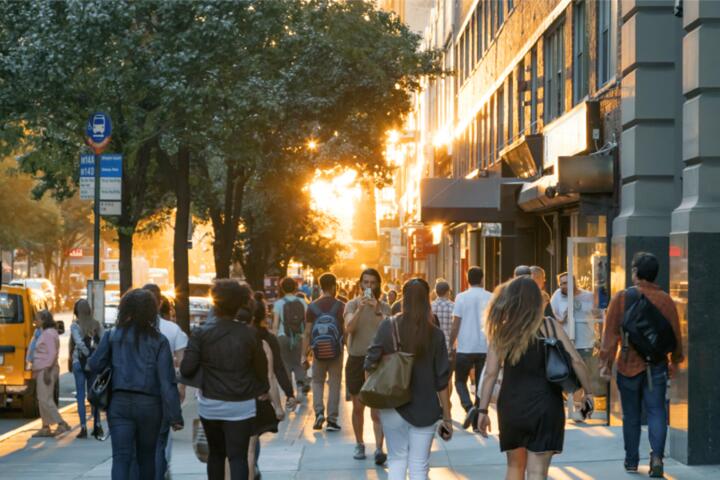
Modern urbanism is moving away from the "Euclidean zoning" of the 20th century, which strictly separated residential areas from commercial hubs. Instead, the focus has shifted to the 15-Minute City concept—an urban setup where all essential human needs (work, groceries, healthcare, education) are reachable within a 15-minute walk or bike ride.
In practice, this looks like the "Superblocks" (Superilles) of Barcelona. By restricting through-traffic to the perimeter of nine-block grids, the city reclaimed 60% of road space for public use. The result wasn't just aesthetic; nitrogen dioxide levels dropped by 25% in these zones, and local business revenue saw a measurable uptick as foot traffic replaced drive-by commuting.
Statistically, the economic argument is undeniable. According to a study by Smart Growth America, walkable urban places (WalkUPs) generate 75% more GDP per square foot than their drivable counterparts. In cities like Washington D.C. or Boston, office rents in walkable neighborhoods command a 100% premium over those in car-dependent suburbs.
Why Most Cities Fail
The primary failure in modern urban design is the "Stroad"—a hybrid between a street (a place where people live and shop) and a road (a high-speed connection between two points). Stroads are dangerous, inefficient, and financially ruinous for municipalities because they require high maintenance costs with low tax yields per acre.
When cities prioritize "Level of Service" (LOS) for vehicles, they inadvertently create "Pedestrian Deserts." This results in the Induced Demand trap: widening a road to reduce congestion actually attracts more cars, eventually leading to the same level of traffic but with a more hostile environment for people on foot.
The consequences are measurable in human lives. Data from the National Highway Traffic Safety Administration (NHTSA) shows that pedestrian fatalities have hit 40-year highs in the US, largely due to high-speed road designs in areas where people are forced to walk across multi-lane highways to reach basic services.
Pedestrian Empowerment
Implementing Tactical Urbanism for Rapid Testing
Instead of waiting for multi-million dollar capital projects, cities are using "Tactical Urbanism"—low-cost, temporary changes like paint, planters, and bollards—to reorganize streets. This allows planners to gather real-world data before pouring concrete. Using platforms like Remix or Streetmix, city officials can simulate these changes to predict impact on traffic flow.
Leveraging the Power of Micro-Mobility Integration
Walking doesn't exist in a vacuum; it is the "first and last mile" of public transit. Successful cities integrate pedestrian paths with services like Lime, Bird, or city-owned bike-share programs. When a sidewalk leads directly to a multimodal hub, the utility of walking increases exponentially. Research indicates that households in high-walkability areas save an average of $7,000 per year on transportation costs.
Utilizing Walk Score and GIS Mapping for Development
Developers now use Walk Score algorithms to determine the "B-class" or "A-class" status of a property. A high Walk Score (above 70) is no longer a luxury; it is a financial de-risking strategy. Real estate platforms like Zillow and Redfin now integrate these metrics because they directly correlate with shorter "days on market" for listings.
Enhancing Thermal Comfort and Biophilic Design
A walkable city must be a comfortable city. In hot climates, this means "Cool Pavement" technology and aggressive canopy targets. For instance, Melbourne’s Urban Forest Strategy aims to increase canopy cover to 40% by 2040. This reduces the "Urban Heat Island" effect, lowering ambient temperatures by up to 4°C, making walking viable even in peak summer.
Solving the "Retail Gap" Through Mixed-Use Zoning
Walkability fails if there is nowhere to walk to. Reforming zoning laws to allow "ADUs" (Accessory Dwelling Units) and neighborhood-scale retail (like corner cafes or small grocers) in residential zones is essential. In cities like Portland, Oregon, the removal of parking minimums for small businesses has allowed unique, walk-in shops to thrive where asphalt parking lots once sat empty.
Urban Success Stories
Case Study 1: The Transformation of Utrecht, Netherlands
Problem: The city was struggling with congestion and a legacy of 1970s highway planning that had paved over historic canals.
Action: Utrecht famously restored its Catharijnesingel canal, replacing a ten-lane motorway with water and pedestrian paths. They also built the world's largest bicycle parking garage at the Central Station, accommodating 12,500 bikes.
Result: Bicycling and walking now account for over 60% of all trips into the city center. Retail vacancy rates dropped to near zero, and the city consistently ranks as one of the happiest urban environments globally.
Case Study 2: The BeltLine in Atlanta, USA
Problem: Atlanta was long considered the poster child for urban sprawl and car dependency.
Action: A public-private partnership repurposed a 22-mile historic rail corridor into a multi-use trail and transit network.
Result: The project has spurred over $8 billion in economic development. Properties within a half-mile of the trail have seen value increases of 60% compared to the city average, proving that people are willing to pay a massive premium for car-free connectivity in a "driving city."
Urban Viability Checklist
| Feature | Car-Centric Design | Pedestrian-Centric Design |
|---|---|---|
| Primary Metric | Vehicle Throughput (LOS) | Person Throughput & Dwell Time |
| Zoning | Single-use (Residential/Commercial) | Mixed-use (Vertical & Horizontal) |
| Parking | Minimums (mandatory stalls) | Maximums (or eliminated) |
| Street Design | Wide lanes, high radii turns | Narrow lanes, tight curb radii |
| Safety | Signs and signals | Physical barriers and "Traffic Calming" |
| Economic Basis | Large-scale retail (Big Box) | Fine-grained retail (Small biz) |
Pedestrian Pitfalls
One common mistake is "Beautification without Function." A city might install expensive benches and sculptures on a sidewalk that leads nowhere. If the path doesn't connect a residence to a destination (like a school or pharmacy), it remains a "decorative" space rather than a "functional" one.
Another error is ignoring the "Last 100 Feet." Planners often build great paths but fail to ensure they are accessible. A sidewalk without curb cuts for wheelchairs or strollers is a failed piece of infrastructure. Compliance with the Americans with Disabilities Act (ADA) or local equivalents is the bare minimum; true walkability requires universal design.
Finally, cities often fail by not pricing street parking correctly. When street parking is underpriced or free, it encourages "cruising" for spots, which accounts for up to 30% of urban traffic congestion. Using dynamic pricing systems like SFPark ensures that there is always one spot available, reducing unnecessary vehicle movement in pedestrian zones.
FAQ
What is the ideal sidewalk width for a busy city?
For commercial areas, a minimum of 15 feet is recommended: 6 feet for a clear walking zone, 4 feet for a "buffer" (trees, lamps), and 5 feet for a "frontage zone" (café seating or window shopping).
Does removing car lanes hurt local businesses?
Multiple studies from Bloomberg CityLab show that replacing parking with bike lanes or wider sidewalks increases retail sales. Pedestrians and cyclists stop more often and spend more per month than drivers, even if they spend less per individual trip.
How do we handle delivery trucks in walkable zones?
Modern solutions involve "Micro-hubs" and cargo bikes. Companies like DHL and UPS are increasingly using electric cargo bikes for the final leg of delivery in dense European and North American city centers to avoid fines and traffic.
Is walkability only for wealthy neighborhoods?
No. In fact, low-income residents are statistically more likely to rely on walking and transit. Ensuring walkability in underserved areas is a matter of "Transportation Equity," reducing the financial burden of car ownership on those who can least afford it.
What is "Daylighting" in urban design?
Daylighting involves removing parking spaces immediately adjacent to crosswalks. This increases the line of sight for both drivers and pedestrians, significantly reducing the risk of collisions at intersections.
Author's Insight
In my years analyzing urban evolution, I've found that the most successful "walkable" projects aren't the ones that look the best in photos, but the ones that feel the most boringly convenient. When walking becomes the "path of least resistance"—easier than finding keys or a parking spot—the city has won. My advice for anyone looking to evaluate a neighborhood is simple: look for the "desire lines" (worn paths in the grass). Those paths tell you exactly where the infrastructure failed and where the people actually want to be.
Summary
Creating a walkable city is an iterative process that requires moving beyond the "car-first" mindset of the last century. By focusing on high-density mixed-use zoning, implementing tactical urbanism, and prioritizing human-scale safety, cities can unlock massive economic and social value. To see real change, local governments must prioritize data from tools like Walk Score and invest in infrastructure that treats the pedestrian as the primary unit of the city. Start by advocating for small, local changes: a new crosswalk, a bike rack, or a reclaimed parking space. These incremental shifts are the foundation of a more resilient, healthy, and profitable urban future.