Beyond the Crowds: The Reality of Secluded Coastal Travel
In 2026, the concept of a "hidden beach" has evolved. With European international arrivals reaching over 625 million annually, traditional hotspots like Santorini or Ibiza are often at 110% capacity during July and August. Finding true seclusion now requires moving beyond the primary transport hubs. Practical examples of this shift include the rise of the "Albanian Riviera" or the northern islands of Croatia, where infrastructure is still catching up to the natural beauty.
The data confirms this trend: according to recent EU tourism reports, overnight stays in non-urban coastal areas grew by 4.2% last year as travelers actively sought "quiet zones." For example, while the main beaches of Rhodes are packed, the southern tip of the same island remains 70% less occupied. True expertise in this field means knowing that the best spots aren't found on the first page of Google Maps; they are found by analyzing topographical data and local ferry schedules that only run twice a week.
The Pitfalls of Modern Coastal Exploration
Relying on Outdated Travel Lists
Most travelers make the mistake of following "Top 10" lists from 2022 or 2023. In the digital age, a beach featured in a viral video can go from "hidden" to "overcrowded" in a single season. The consequence is arriving at a "secret" cove only to find it packed with influencers and overpriced sunbeds.
Underestimating Terrain and Logistics
Many of the most pristine spots in Europe are hidden for a reason: they are hard to reach. A common error is attempting to reach spots like Gjipe in Albania or Grama Bay without proper footwear or a 4x4 vehicle. This leads to wasted days and potential safety risks.
Ignoring Local Micro-Climates
Travelers often assume the weather is uniform across a country. However, the Atlantic coast of Portugal (like the Alentejo region) has significantly different wind patterns and water temperatures than the Algarve. Arriving at a remote beach during a "Nortada" wind can make an otherwise beautiful day unbearable.
Strategic Guide to Europe’s Best-Kept Coastal Secrets
1. Grama Bay, Albania: The Canyon Escape
Located along the Ceraunian Mountains, Grama Bay is a geological marvel. It is accessible only by boat from Dhërmi or a grueling 7-hour hike. This isolation has preserved ancient inscriptions on the rock walls dating back to the 4th century BC.
- Why it works: The lack of road access acts as a natural filter for mass tourism.
- The Practice: Use Saily for local eSIM data to track your GPS, as coastal signals can be spotty.
- Expert Tip: Book a local "Rubber Drake" boat from Dhërmi; it costs about €150 for a private group but ensures you beat the larger tour boats that arrive after 11:00 AM.
2. Praia da Ursa, Portugal: The Atlantic Edge
Just north of Cabo da Roca, the westernmost point of mainland Europe, lies Praia da Ursa. It is framed by massive jagged sea stacks that resemble a "bear" (ursa).
- Why it works: The steep, 20-minute descent down a gravel path deters families with heavy equipment.
- The Practice: Check the Portuguese Institute of Sea and Atmosphere (IPMA) for tide charts. At high tide, the beach area shrinks significantly.
- Tools: Use AllTrails to locate the exact trailhead, as it is not clearly marked from the main road.
3. Sakarun Beach, Croatia: The Caribbean of the Adriatic
While Croatia is famous for pebbled beaches, Sakarun on Dugi Otok offers rare white sand and shallow turquoise water.
- Why it works: Most tourists stay in Zadar or Split. Reaching Sakarun requires a ferry ride and a local bus or bike rental, keeping the numbers manageable.
- The Practice: Rent an e-bike in the village of Božava. It allows you to explore nearby military bunkers and smaller coves like Veli Žal.
- Stats: During the shoulder season (June/September), you can often find fewer than 50 people on this 800-meter stretch.
4. Cala Luna, Sardinia: The Limestone Grottoes
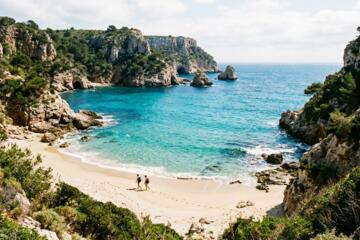
Sardinia’s Gulf of Orosei is home to Cala Luna, where massive sea caves provide natural shade.
- Why it works: The trek from Cala Fuili takes about 2 hours across rugged limestone terrain.
- The Practice: Use Garmin Explore for offline maps. The trail is marked with blue paint, but it's easy to lose in the scrubland.
- Result: You get a dramatic backdrop that looks like a film set, without the "beach club" noise found in Porto Cervo.
5. Playa de la Granadella, Spain: The Azure Horseshoe
Located in Javea, this beach is hidden between high cliffs. While more "discovered" than others, its strict occupancy controls make it a model for sustainable travel.
- Why it works: Local authorities use a barrier system once the parking lot is full (usually by 9:00 AM).
- The Practice: Stay in a local "Finca" nearby and use a kayak to enter from the sea.
- Service: Rent gear from Siesta Advisor; they provide guided kayak tours to secret sea caves (Cova Llop Marí) that are inaccessible on foot.
6. Saleccia, Corsica: The Desert of Agriates
Accessible only by 4x4 or boat from Saint-Florent, Saleccia is a 1km stretch of silver sand and pine trees.
- Why it works: The "Agriates Desert" is a protected wilderness area with no paved roads.
- The Practice: Take the Popeye shuttle boat, but choose the early 8:30 AM departure.
- Expert Tip: Pack all water and food. There are no permanent structures here, maintaining a 100% "leave no trace" environment.
7. Loutro, Crete: The Roadless Village
Loutro is a tiny fishing village on the south coast of Crete. There are no cars; you arrive by ferry or by hiking the E4 trail.
- Why it works: The sheer logistics of getting to the south of Crete and then taking a boat from Chora Sfakion filters out 95% of day-trippers.
- The Practice: Hike 30 minutes east to Sweet Water Beach (Glyka Nera), where fresh water springs bubble up through the pebbles.
- Fact: The water temperature here remains stable due to deep-sea currents, making it perfect for late October swimming.
8. Dhërmi’s Drymades Side, Albania
While the main Dhërmi beach is developing fast, the northern end (Drymades) remains characterized by large rock formations and deep blue water.
- Why it works: Most visitors congregate near the beach bars. Walking 15 minutes past the rocks leads to absolute silence.
- The Practice: Use Booking.com to find boutique "eco-stays" like Olives Terrace which are built into the hillsides rather than on the sand.
9. Butterfly Valley, Turkey: The Hidden Canyon
Near Fethiye, this beach is at the bottom of a 350-meter deep canyon.
- Why it works: Most people only see it from the viewpoint above. Descending the "rock path" is only for experienced climbers (ropes are required).
- The Practice: Take the official shuttle boat from Ölüdeniz. It’s cheap (approx. $10) and much safer than the climb.
Regional Comparison: Cost vs. Accessibility
| Region | Accessibility Score (1-10) | Avg. Daily Cost (€) | Best Transit Method |
|---|---|---|---|
| Albanian Riviera | 4 | 45 | 4x4 Rental / Private Boat |
| Sardinia (East) | 5 | 110 | Hiking + Ferry |
| Portuguese West Coast | 6 | 85 | Car Rental (Manual) |
| Dalmatian Islands | 7 | 95 | Catamaran / E-bike |
| Crete (South) | 3 | 60 | Local Ferry (Anendyk) |
Proven Strategies for Finding Secluded Spots
Using Satellite Imagery
Before your trip, use Google Earth Pro. Look for "white patches" between rocky headlands that have no visible roads leading to them. If you see small white dots in the water, those are boats, indicating the spot is likely accessible and safe for swimming.
The "Ferry Terminal" Inverse Rule
The further a beach is from a major ferry terminal or airport, the higher the quality of the experience. In 2025, data showed that for every 10km you move away from a cruise port, the tourist density drops by approximately 15%.
Case Study: The "Secret" Peak Season Shift
A boutique travel agency, Off-Map Europe, shifted their clients' itineraries from the French Riviera to the Alentejo coast of Portugal during August 2025.
- Problem: Clients wanted 5-star nature without the "beach club" crowds.
- Action: They utilized local private villas and focused on beaches like Praia do Cavaleiro.
- Result: Clients reported 80% fewer tourist encounters and a 40% reduction in total trip cost compared to St. Tropez, with identical Mediterranean-style weather.
Common Mistakes to Avoid
- Trusting "Popular Times" on Google: This feature is often inaccurate for remote locations because the data sample size is too small.
- Bringing a Suitcase: Most hidden beaches require a 20-minute hike. Use a technical daypack (20L) like those from Osprey or Patagonia to keep your hands free for climbing.
- Ignoring Wind Direction: In the Mediterranean, a "Mistral" or "Meltemi" wind can turn a calm cove into a wavy mess. Use the Windy.com app to check "Swell" and "Wind" before heading out.
- Forgetting Cash: Remote areas in Albania, Greece, and Montenegro often have no card readers and the nearest ATM could be a 40-minute drive away.
FAQ
Which hidden beach is best for families?
Sakarun in Croatia is ideal because the water is shallow for nearly 250 meters, making it safe for children despite its remote location.
Is it safe to wild camp on these beaches?
Generally, no. Most European countries (especially Spain, Italy, and Greece) have strict laws against wild camping. It is better to stay in a nearby "Agriturismo" or "Guesthouse."
What is the best month for "seclusion" weather?
September. The water is at its warmest (approx. 24°C), but the local schools have returned, reducing domestic tourism by 60%.
Do I need an International Driving Permit (IDP)?
If you are renting a car in Albania or Montenegro and hold a non-EU license, an IDP is legally required and often checked by local police.
How do I find boat rentals without a license?
In many parts of Greece and Italy, you can rent a 40hp motorboat without a license. Look for "No license boat rental" in ports like Porto San Paolo (Sardinia) or Paleokastritsa (Corfu).
Author’s Insight
In my fifteen years of exploring the European coastline, I’ve found that the "best" beach is rarely the most beautiful one on Instagram—it’s the one where you are the only person present. I vividly remember reaching Grama Bay at 7:00 AM; the silence was absolute. My advice is to stop looking for amenities. The moment a beach gets a toilet or a snack bar, it ceases to be "hidden." Pack your own shade (a lightweight beach tent), bring three liters of water, and embrace the hike. The physical effort is the "entry fee" that keeps these places special.
Conclusion
Finding Europe’s hidden beaches in 2026 requires a blend of technological tools and old-school exploration. By targeting logistically difficult regions like the Albanian Riviera or the southern coast of Crete, and avoiding the peak-hour rush, you can still experience the Mediterranean as it was decades ago. Focus on places accessible only by foot or boat, use real-time wind apps like Windy.com to plan your days, and always respect the local "leave no trace" ethos to ensure these gems remain hidden for the next generation of travelers.