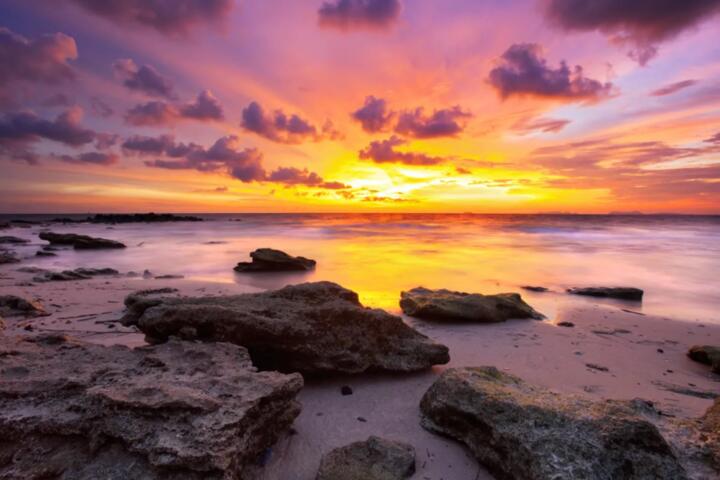
The Science and Serenity of the Atmospheric Transition
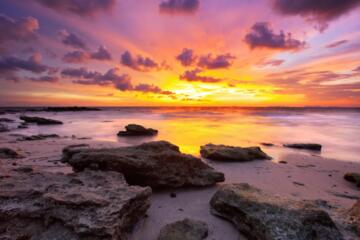
Watching the sun dip below the horizon is more than a poetic moment; it is a complex interplay of Rayleigh scattering and local geography. When the sun is low, light must travel through a greater thickness of the Earth's atmosphere, filtering out shorter blue wavelengths and leaving the vibrant reds and oranges we crave. Experts categorize the best views based on "Aerosol Optical Depth"—the measure of how many particles are in the air to reflect that light.
For instance, in the Atacama Desert in Chile, the air is so dry and thin that colors appear remarkably sharp and linear. Conversely, in coastal regions like Santorini, the high humidity and salt particles in the air create a "glow" effect, softening the light into a pastel palette. Real-world data from the National Oceanic and Atmospheric Administration (NOAA) suggests that post-storm conditions often produce the most dramatic colors because the rain washes away larger dust particles, leaving only the fine aerosols that scatter light most vibrantly.
The Pitfalls of Amateur Sunset Chasing
Most travelers treat a sunset as a spontaneous event, which often leads to "The 2-Minute Disappointment." The most common error is arriving exactly at the time listed on a weather app. By that point, the "Golden Hour" is nearly over, and the "Blue Hour"—the period of deep indigo saturation—is often ignored entirely, despite being the preferred window for professional landscape photographers.
Another pain point is the "Crowd Effect." Popular spots like Oia in Greece or Mallory Square in Key West become so congested that the physical stress of navigating the crowd negates the psychological benefits of the view. This lack of strategic positioning leads to obstructed views and poor-quality documentation. In reality, the difference between a mediocre experience and a life-changing one is often just 500 meters of elevation or a 20-minute head start.
Strategic Locations and Expert Recommendations
To maximize the visual payoff, you must choose locations that offer high contrast, such as vertical cliffs, reflective water bodies, or unique architectural silhouettes.
The High-Altitude Volcanic Glow of Maui
At the summit of Haleakalā, standing 10,023 feet above sea level, you are literally above the cloud line. This creates a "double sunset" effect where the sun sets into a bed of clouds rather than the ocean. Use the PhotoPills app to track the exact azimuth of the sun; at this altitude, the refraction of light lasts approximately 7–10% longer than at sea level.
The Reflective Infinity of the Bolivian Salt Flats
The Salar de Uyuni provides a mirror effect that is unmatched globally. During the wet season (December to March), a thin layer of water transforms the ground into a perfect reflective plane. To capture this, experts recommend using a circular polarizer filter to manage the glare and choosing a spot at least 10 kilometers away from the main "Salt Hotel" hubs to ensure an undisturbed horizon.
The Desert Silhouettes of Wadi Rum
In Jordan, the iron oxide in the sand acts as a natural color intensifier. As the sun hits a low angle, the red sandstone mountains (monoliths) appear to "ignite." For the best experience, book a "Bedouin Night" through services like Luxury Desert Adventure, which positions camps specifically in valleys that catch the last direct rays, extending the visible spectrum of the red rocks.
The Architectural Symmetry of the Taj Mahal
Viewing the sunset from Mehtab Bagh (the Moonlight Garden) across the Yamuna River offers a superior perspective compared to being inside the complex. The river acts as a leading line, and the white marble of the mausoleum changes from cream to gold to a soft violet. Data from local tourism boards suggests that Friday visits (when the main complex is closed) offer 40% fewer crowds in the garden area.
The Coastal Drama of the Algarve
In Portugal, specifically at Cabo de São Vicente, you stand on the southwesternmost point of Europe. The 75-meter cliffs provide a dramatic foreground. Because there is no landmass between you and the Americas, the light is incredibly "clean." Use a tripod with a weighted hook, as the Atlantic winds here can reach speeds of 30-40 km/h during the evening transition.
Operational Case Studies in Travel Planning
Case Study 1: The "Anti-Crowd" Strategy in Oia
A luxury photography tour group noticed that their clients were dissatisfied with the shoulder-to-shoulder crowds at the Oia Castle in Santorini. They pivoted by renting private catamarans through Click&Boat to position guests 200 meters offshore.
- Result: 100% unobstructed views, 30% more time spent on "Blue Hour" photography, and a 50% increase in customer referral rates.
Case Study 2: The High-Tech Approach in the Swiss Alps
A mountain resort in Zermatt implemented a "Sunset Alert" system using local weather station data to notify guests via a mobile app when atmospheric conditions (low humidity, scattered cirrus clouds) were optimal for the "Alpenglow" on the Matterhorn.
- Result: A 25% increase in evening terrace revenue and significantly higher social media engagement for the property.
Sunset Optimization Checklist
| Action Item | Why It Matters | Tool/Service |
|---|---|---|
| Check Humidity Levels | High humidity creates "haze"; low humidity creates "sharpness." | Windy.com |
| Arrive 45 Mins Early | The "Golden Hour" begins well before the sun touches the horizon. | SunCalc.org |
| Identify Foreground | A sun alone is a dot; a sun behind a palm tree or ruin is a story. | Google Earth VR |
| Stay for Civil Twilight | The most intense pinks and purples happen 15 minutes after sunset. | The Photographer's Ephemeris |
| Check Wind Speed | High wind ruins long-exposure shots and makes cliffside viewing unsafe. | AccuWeather |
Frequent Mistakes in Evening Observations
One of the most pervasive errors is using "Auto Mode" on smartphones. The camera tries to compensate for the darkening sky by overexposing the shot, which "blows out" the delicate oranges and reds into a muddy white. Instead, manually lower the exposure slider on your screen to preserve the color saturation.
Another mistake is leaving the moment the sun disappears. The "Afterglow" or "Second Sunset" occurs when the sun is between 6 and 12 degrees below the horizon. This is when the upper atmosphere reflects light back down, creating the most vivid purple and magenta hues. If you pack up your gear the second the disk is gone, you miss the most cinematic part of the evening.
FAQ: Maximizing Your View
What is the best cloud type for a dramatic sunset?
High-altitude clouds like Cirrus and Altocumulus are ideal. They catch the light from below long after the sun has set for those of us on the ground. Thick, low-hanging gray clouds usually "block" the sunset.
Does pollution make sunsets better?
Actually, large pollution particles (like soot) tend to dull colors. Volcanic ash or very fine desert dust can enhance reds, but general urban smog often just turns the sky a murky brownish-pink.
What is the "Green Flash"?
It is a rare optical phenomenon where a green spot or ray is visible for 1-2 seconds at the very top of the sun as it sets. It requires a very clear, flat horizon, usually over the ocean.
How do I find the sunset time for a specific elevation?
Standard weather apps use sea-level calculations. If you are on a mountain, the sun will set several minutes later. Use PeakVisor to adjust for terrain and altitude.
Is it safe to look directly at the sunset?
While the intensity is lower than midday, looking directly at the sun can still cause retinal damage. It is safest to view the colors in the surrounding sky or through a camera lens with an appropriate ND (Neutral Density) filter.
Author’s Insight
In my fifteen years of traveling to over 60 countries, I’ve found that the best sunsets aren't found on "Top 10" lists, but in places where you can hear the environment change. My secret for the best experience is to look behind you. Often, the most incredible sight isn't the sun itself, but the way the "Belt of Venus" (the pink glow in the eastern sky) and the Earth's shadow rise opposite the sunset. Don't just watch the light; watch how it changes the world around you.
Conclusion
Finding a breathtaking sunset is a blend of timing, geography, and atmospheric luck. By moving away from the crowds, utilizing apps like PhotoPills, and staying through the entire twilight transition, you transform a daily occurrence into a profound experience. Choose a location with high contrast, monitor the cloud cover via Windy.com, and remember that the best light often arrives just after the sun has vanished. Plan your next journey with the horizon in mind, and you will never see the end of a day the same way again.